What is the nasolabial angle?
There are several important angles in rhinoplasty. Today, let us discuss the nasolabial angle. The nasolabial angle refers to the angle of the line connecting the nasal tip to the upper lip. Textbooks consider an ideal nasolabial angle to be around 95 to 105 degrees for women and around 90 to 95 degrees for men. When the nasolabial angle is wide, the nose often looks upturned; when it is acute, the nasal tip often looks drooping. In particular, most people with a protruding mouth have an acute nasolabial angle. Correcting the nasolabial angle involves considering whether the nose is drooping or upturned, whether the philtrum appears long or short, and whether a protruding mouth is present.
2. Methods for correcting the nasolabial angle
The approach to correcting the nasolabial angle is relatively straightforward. Filling the deep area where the columella meets the philtrum with filler, autologous fat, donor dermis, autologous dermis, implants, or cartilage can correct the nasolabial angle, though maintaining this effect stably over time requires refined surgical skill. In addition, favorable results are achieved when performed alongside rhinoplasty.
1) When the nasolabial angle is acute
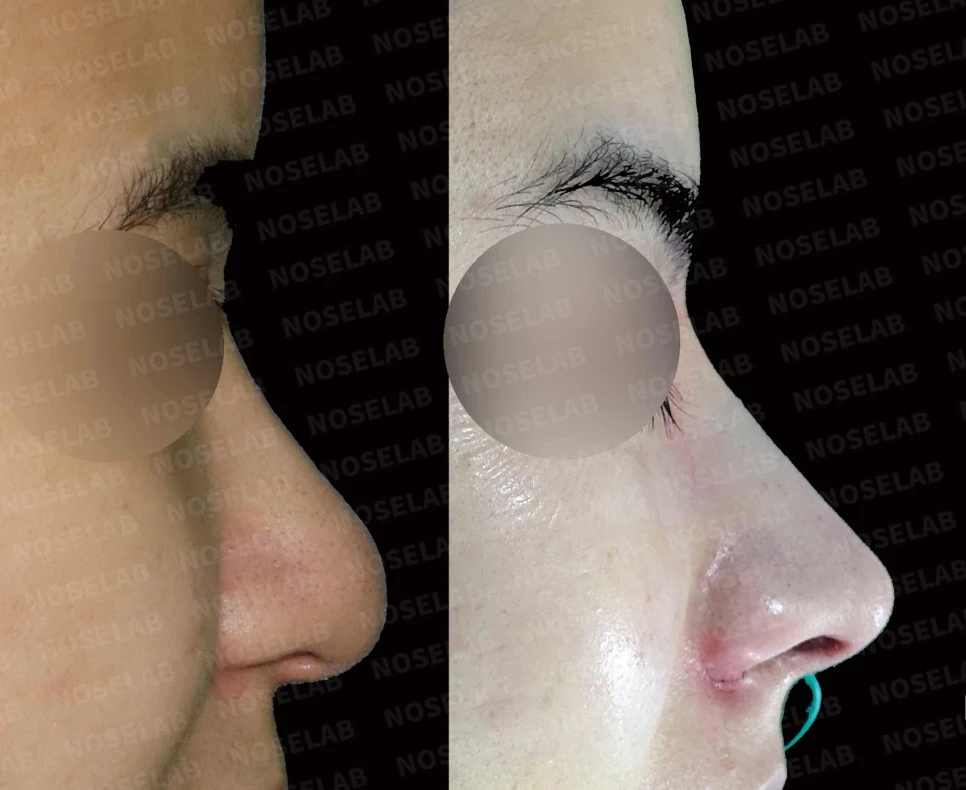
When the nasolabial angle is acute, the nasal tip can droop and appear like an arrow nose, and most people with a protruding mouth have an acute nasolabial angle.As a result, the face can appear heavy and aged. In such cases, elevating the drooping nasal tip can correct the nasolabial angle.
When the nasal tip is drooping, simply projecting the tip can slightly widen the nasolabial angle; however, for definitive correction of the nasolabial angle, the columella must be lowered securely. Lowering the columella slightly helps create a natural, well-shaped nasal tip, and it is fair to say that lowering the columella is essentially done to refine the nasolabial angle. However, lowering the columella in rhinoplasty is a procedure that requires considerable surgical expertise.
2) When the nasolabial angle is wide
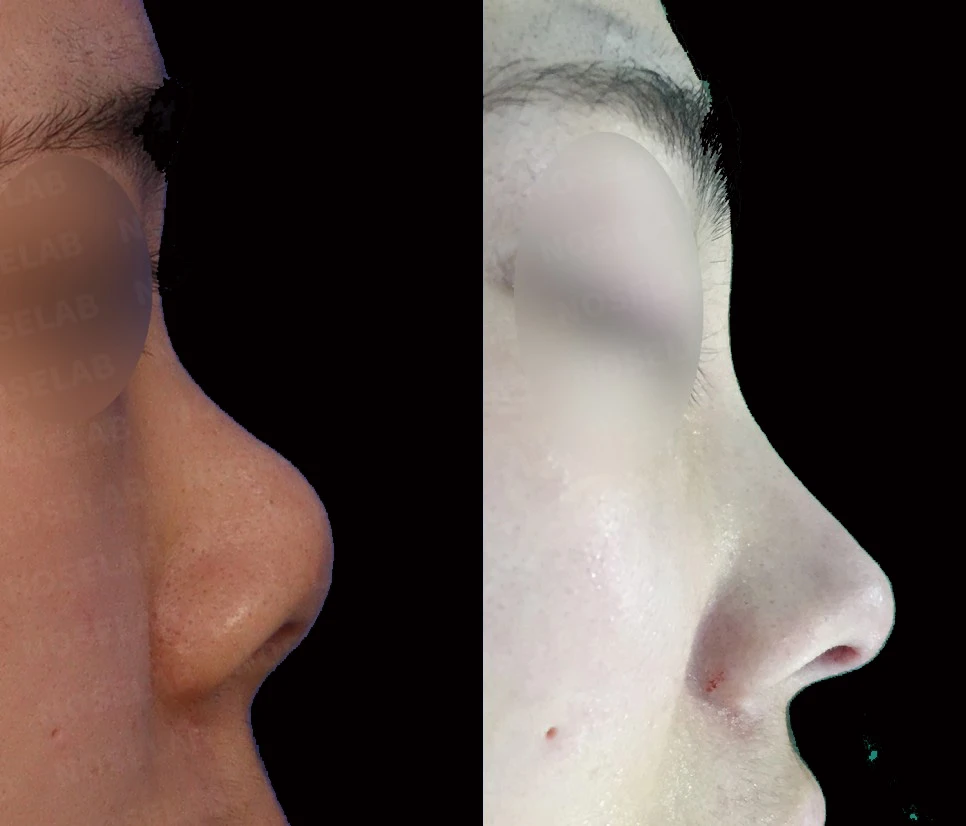
When the nasolabial angle is wide, the nasal tip can appear upturned. An upturned tip means more nostril show from the front. In addition, the philtrum may appear longer.
To reduce the nasolabial angle, the upturned nasal tip must be corrected. Performing septal extension using sturdy cartilage between the lower lateral cartilages can bring the upturned nasal tip down. At times, a technique that secures the lower columella to the anterior nasal spine is also used.
Surgery to correct the nasolabial angle takes roughly 20 to 30 minutes, and because the angle of the nasal tip must be controlled, sturdy cartilage such as septal cartilage or rib cartilage is needed.
This concludes our brief overview of #nasolabialanglecorrection. I hope this serves as a helpful reference for anyone with questions regarding this topic.
Dr. Peter C. Kang, Medical Director of NOSELAB